photos by Mike Carrell.
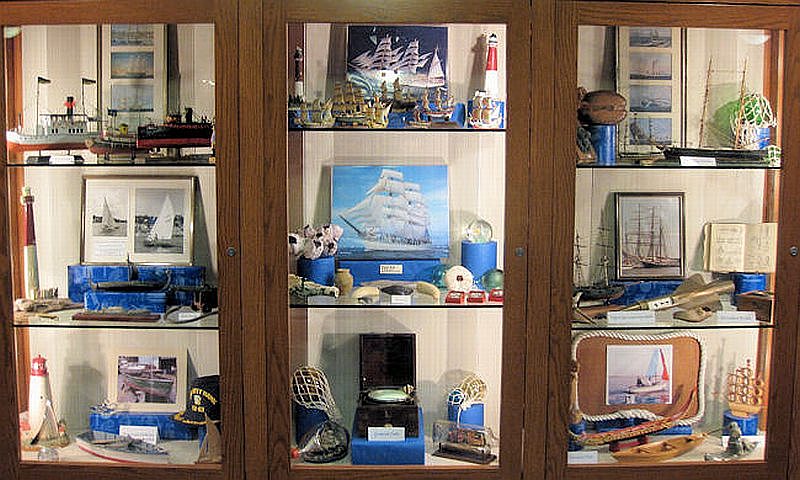
Residents contributed many items related to ships and the lives of sailors for the summer 2009 nautical-theme display case presentation. The result is a fabulous exhibit, with models of some very well known sailing ships and stories behind some of the pieces.
The
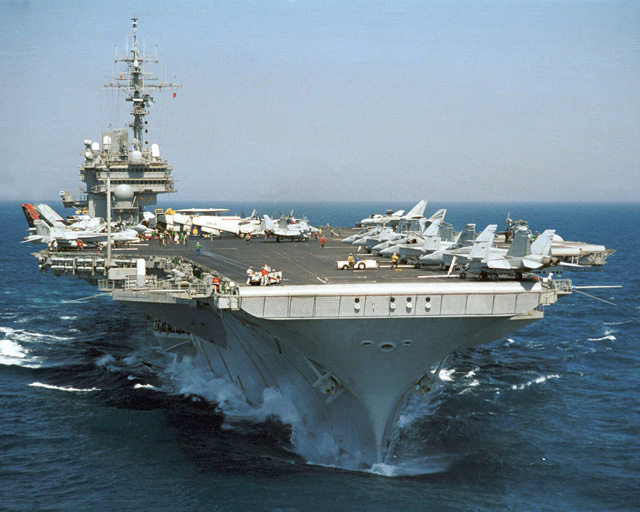
striking painting in the top center of the case is of the US Coast Guard
Barque Eagle
which is 295 feet.
Video of the Barque Eagle and its crew.
First the entire case, then closeups and text for each of the nine sections
Top
Row
Left Column
Click image to see larger photo in a new window.
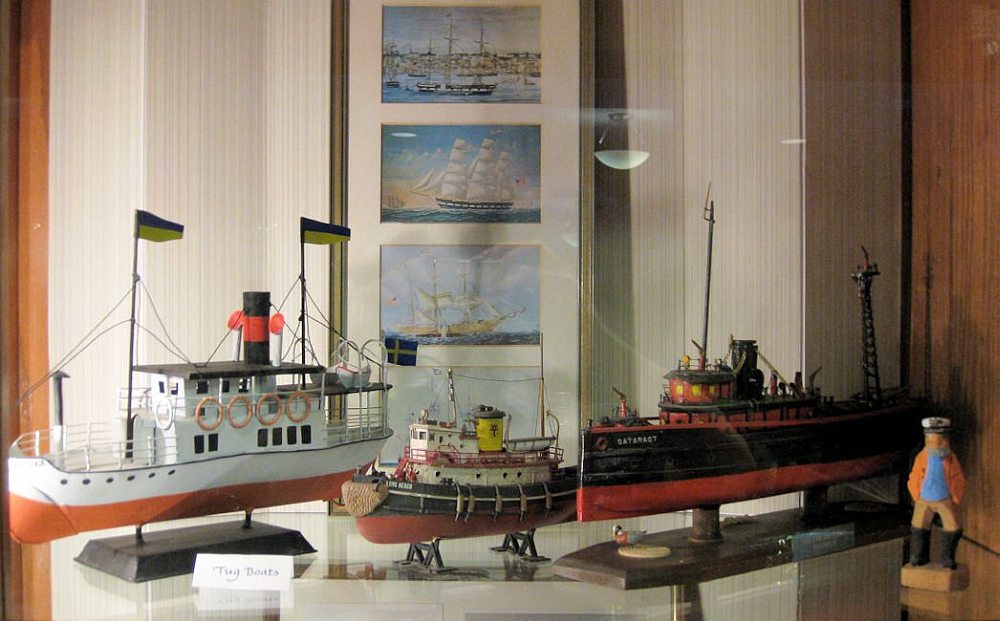
The carved seaman at the right stands in front of a model of the Cataract, a fireboat that served in Baltimore from 1911 to 1962. In the Center is a tug called Long Beach. The model of the passenger boat at left has blue and yellow flags which show that it's of a Swedish vessel. There is a separate piece of metal, a false bow, for protection from ice.
Middle
Row
Left Column
Click image to see larger photo in a new window. Then click large photo to make it even larger.
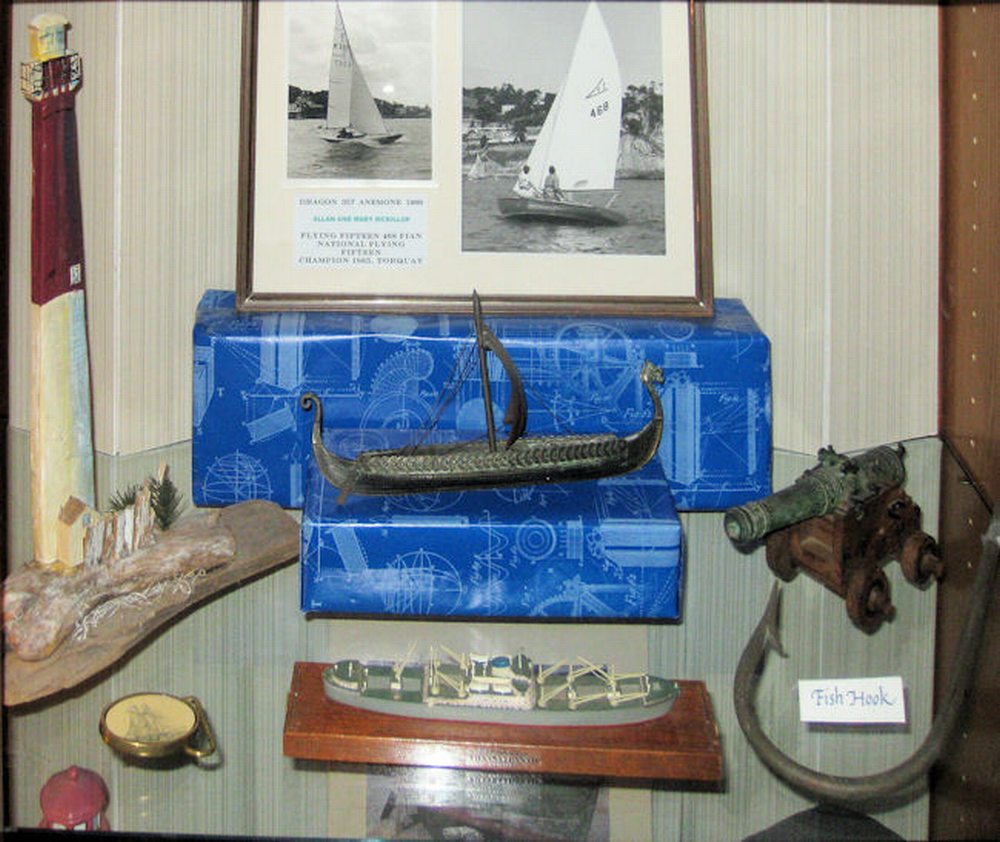
The photographs are of boats owned by Allen and Mary McKillop. The captions read, " "
Barnegat Lighthouse is at left. Above the fish hook is a ship's cannon with wooden, not metal wheels to protect the deck. Below the metal viking boat is a transatlantic freighter which is equipped with about a dozen cranes. .
Bottom
Row
Left Column
Top
Row
Center Column
Click image to see
larger photo in a new window.
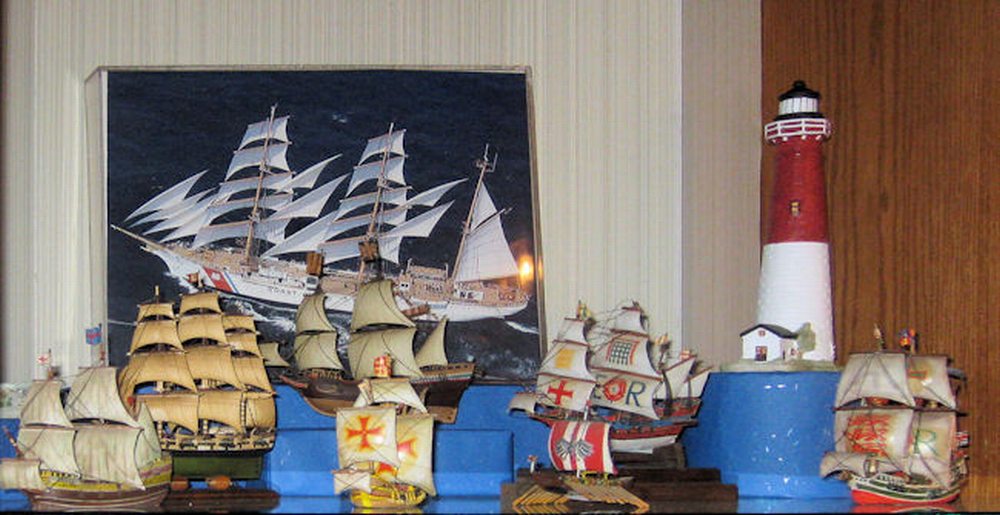
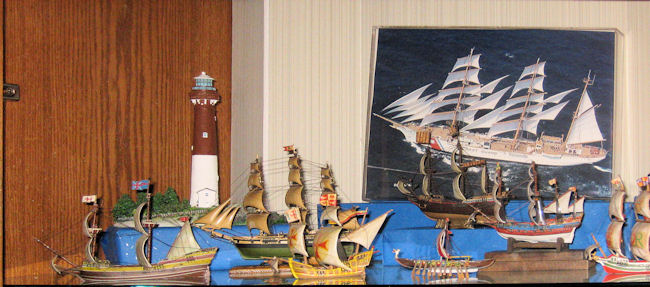
It takes two photographs (above and below) to get a good view of everything on this shelf with two models of Barnegat Light. The painting is of a US Coast Guard barque Eagle which is 295 feet.. Video of the Barque Eagle and its crew. Another video: On the Wings of Eagle
From this perspective, directly in front of the painting is a model of the Mayflower. In the center in front of the Mayflower is a model of the Nina. The Pinto is at the right, and the Santa Maria is behind the small viking longboat. At left there are models of two unidentified tall ships. The photograph below shows the second lighthouse and the same ships from a different angle.
Top
Row
Center Column
from
another angle
Middle
Row
Center Column
Click image to see larger photo in a new window.
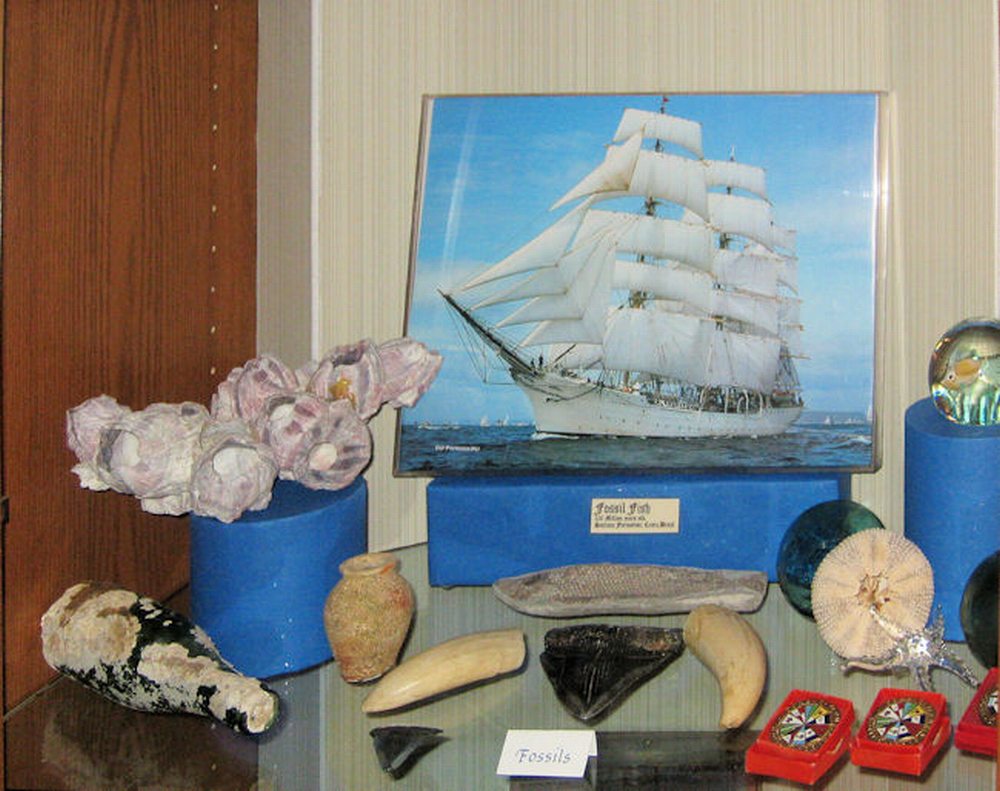
The photograph shows Dar Pormoza a frigate built in 1909. From 1929 to 1962, and again after the war, she was the training ship of Poland. In the 1970s she took part in several Operation Sail and Cutty Sark Tall Ships' Races, winning the 1st place and Cutty Sark Trophy in 1980.
At the base of the photo is a fossil fish. There are two fossil shark's teeth, walrus tusks, an ornamental glass starfish in front of a sea urchin, large barnacles, and an encrusted bottle which.somehow made its way to shore.
Bottom
Row
Center Column
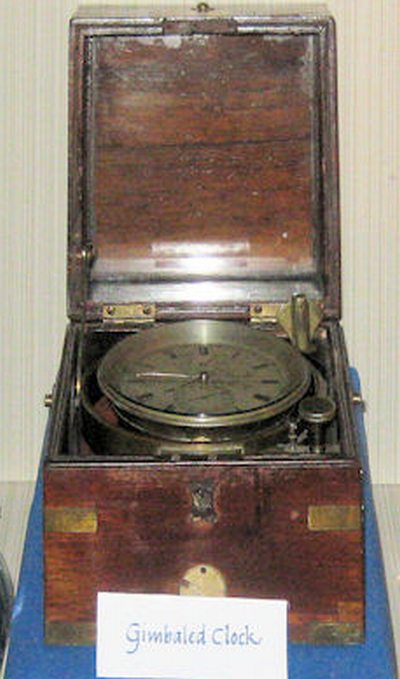
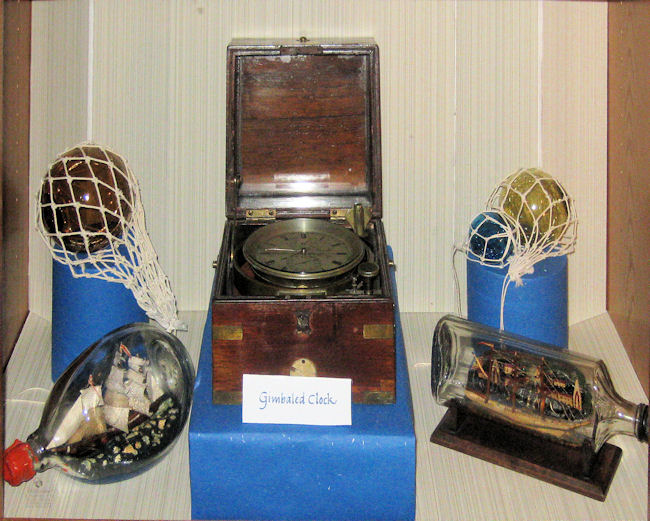
Along with the two ships in bottles and the fishermen's nets with spherical glass floats is a gimbaled clock which was made in Liverpool, England. The middle-right shelf contains a gimbaled compass. Two excerpts from an interesting article in Wikipedia about gimbals:.
"A gimbal is a pivoted support that allows the rotation of an object about a single axis. A set of two gimbals, one mounted on the other with pivot axes orthogonal, may be used to allow an object mounted on the innermost gimbal to remain immobile (e.g. vertical in the animation) regardless of the motion of its support. For example, gyroscopes, shipboard compasses, stoves and even drink holders typically use gimbals to keep them upright with respect to the horizon despite the ship's pitching and rolling."
"The gimbal was first invented by the Greek inventor Philo of Byzantium (280–220 BC). Philo described an eight-sided ink pot with an opening on each side, which can be turned so that while any face is on top, a pen can be dipped and inked - yet the ink never runs out through the holes of the other sides. This was done by the suspension of the inkwell at the center, which was mounted on a series of concentric metal rings which remained stationary no matter which way the pot is turned."
Top
Row
Right Column
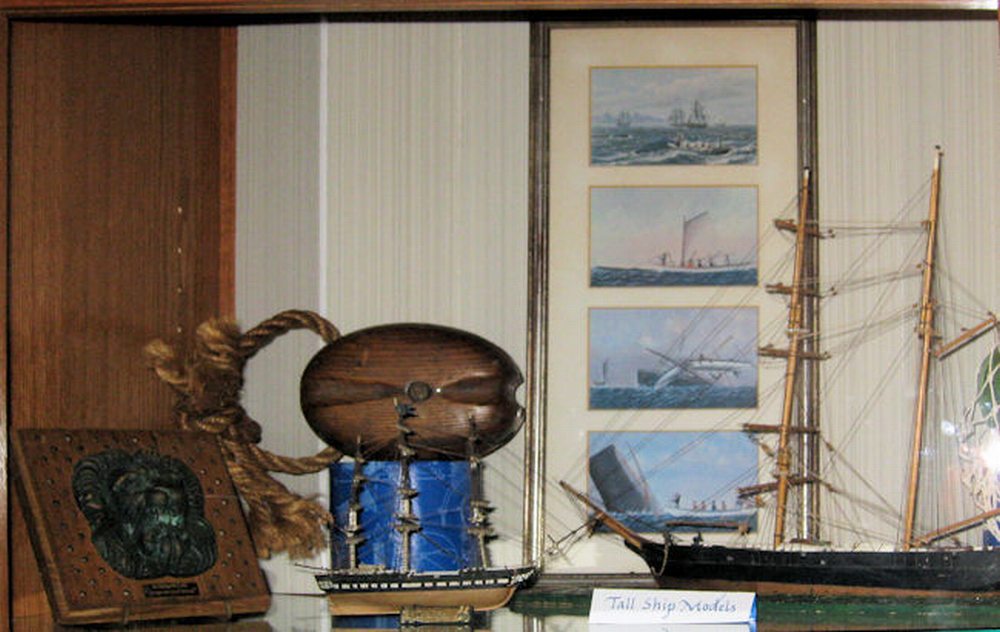
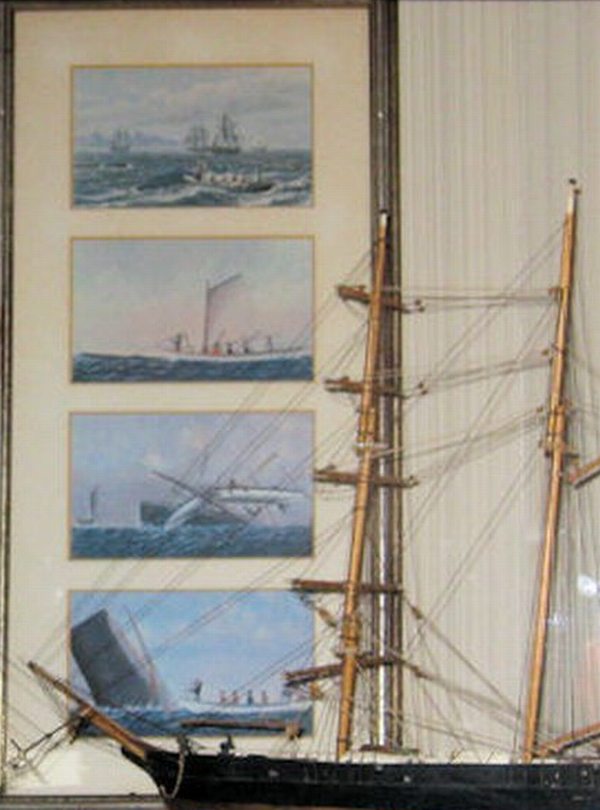
At the left is a block and tackle. Wikipedia has a good explanation, with diagrams and photographs. Look closely at the model and near the masts you'll see tiny little blocks on the lines. See closeup. In the same closeup take a look at the four small whaling paintings in one frame.
Middle
Row
Right Column
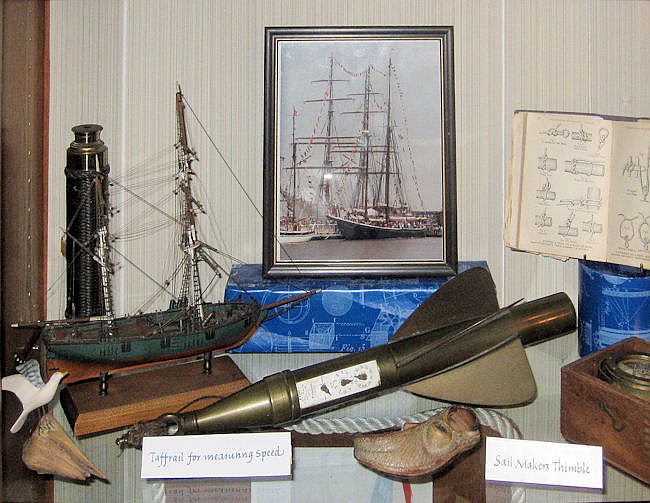
As a toddler Steve Denham played with the Taffrail Log in this case. It's
the metal object with dials. Read
Steve's short article about taffrail logs in general and this one in particular.
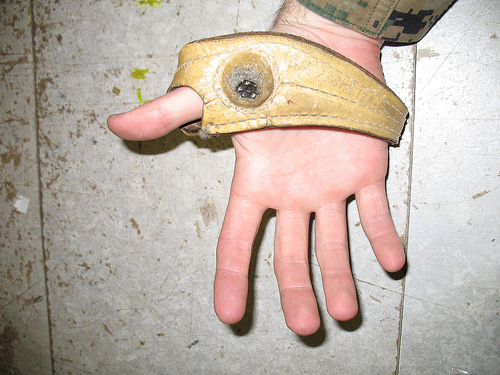
Below the Taffrail Log there is a leather object labelled "Sail Maker's Thimble.:" Actually it's more commonly called a sailmaker's palm because it's the palm of the hand which pushes the needle. This photo shows how one is worn. The pressure point is the small dark circle within the tan circle. The one on dispaly is an antique which was no doubt used by other sailors many decades before Mary McKillop and her late husband Allen used it for repair work on their boats' sails
The model in front of the telescope is a warship with several tiny little cannons. The box at the right of the photo holds a gimbaled compass. Above the compass an antique book, Marlinspike Seamanship, is open to a chapter on cordage. Wikipedia explains the tool called marlinspike through text and photographs and has a separate page on marlinspike seamanship which begins, "Ropework or Marlinespike Seamanship is the set of processes and skills used to make, repair, and use rope. This includes tying knots, splicing, making lashings, and proper use and storage of rope. In the 16th, 17th, and 18th centuries the skill of a sailor was often judged by how well he knew knots and marlinespike seamanship."
Bottom
Row
Right Column
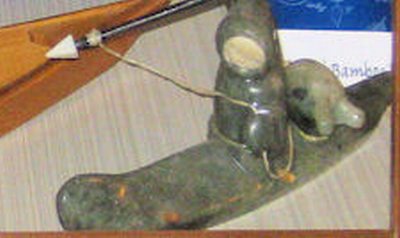
At the bottom right is an Inuit alabaster carving of an sealer with a
harpoon and a seal on deck. (Closeup).
It was given to Ellie and the late Saul Stimler, by their daughter and
her husband in gratitude for the Stimlers having made the down payment
on their first home in Anchorage.
The wooden carving at left appears to be a New England fisherman. At right
is a southeast asian model made of bamboo.
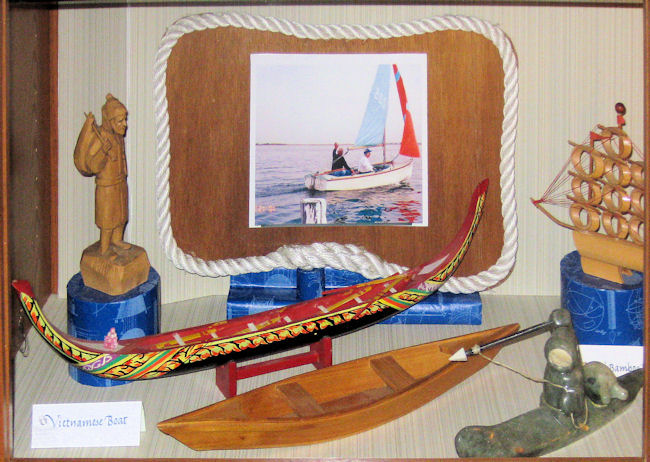
The picture in the plaque edged with line is Ellie and Saul in their sailboat the last time they went sailing, October 14, 2001, after about 35 years as sailors.
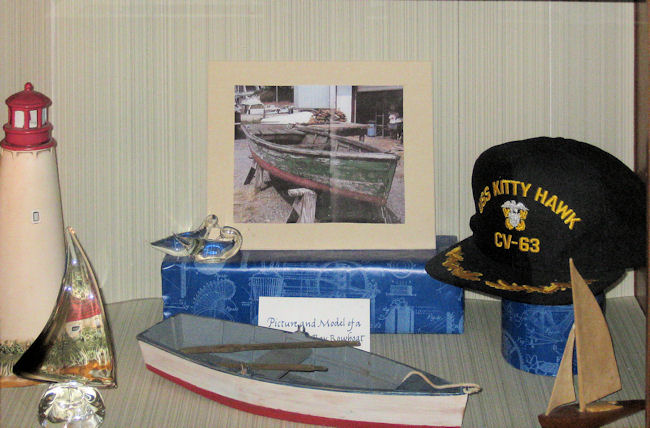
The red row-boat with
painted decorations, in front of the Stimler picture, was given to Warren
Sawyer about four or five years ago after he and Neil Hartman went to
Vietnam and Cambodia to work with the Heifer Project. The organization
Heifer International, which today has many programs, grew out of "Heifers
for Relief" a project of the Church of the Brethren which was established
in 1942.
http://www.heifer.org/ ... history
at http://en.wikipedia.org/wiki/Heifer_International